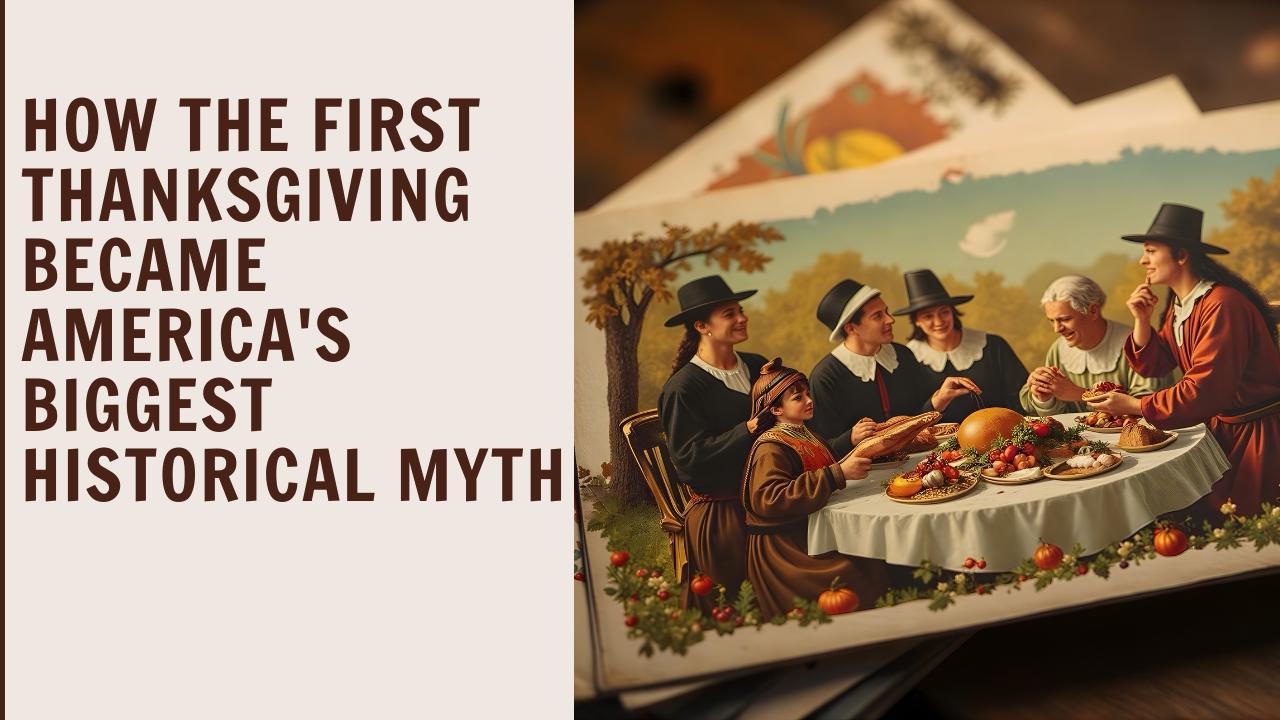
How the First Thanksgiving Became America's Biggest Historical Myth
Everything You Learned in School Was Basically Victorian Fan Fiction
Watch the full video on our YouTube channel: Click here
Pop quiz:
What do you know about the first Thanksgiving?
Pilgrims in black clothes with buckle hats sitting at a long table with Native Americans, sharing turkey and pumpkin pie in a celebration of friendship and gratitude, right?
Wrong. Almost completely wrong.
The Thanksgiving story taught in American elementary schools bears almost no resemblance to what actually happened in 1621.
The buckle hats?
Never existed in that era.
The turkey and pumpkin pie?
Nope.
The harmonious friendship celebration?
Way more complicated than that.
The Thanksgiving we know the story, the imagery, the traditions was largely invented by Victorian Americans in the 1800s who wanted a nice origin story for their country.
They took a three-day harvest celebration from 1621, removed all the messy political complications, added a heavy dose of romantic sentiment, and created an American foundation myth.
This is the story of how Thanksgiving became America's favorite historical fiction.
What Actually Happened in 1621 The Real Context:
Survival, Not Celebration
Let's start with what we actually know about the 1621 event that would later be called "the first Thanksgiving."The English colonists who didn't call themselves "Pilgrims," that term came 200 years late had arrived in December 1620.
Possibly the worst time to arrive in New England if you're unprepared for winter.That first winter was catastrophic. Of the 102 passengers on the Mayflower, only 53 survived to see spring. Disease, starvation, and exposure killed nearly half the group. They were refugees from religious persecution in England, trying to establish a colony in a harsh environment they didn't understand.
By fall 1621, they'd managed to grow enough crops to survive another winter. Someone we don't know who decided to have a harvest celebration.
This wasn't unusual.
Harvest festivals were a common English tradition. You worked hard all year, you brought in the crops, you celebrated with a feast. Standard practice.
This celebration lasted three days.
It happened sometime between late September and early November 1621. We don't know the exact date.And crucially: They didn't call it "Thanksgiving." They called it a harvest celebration. In Puritan terminology, a "thanksgiving" was a solemn religious day of prayer and fasting basically the opposite of a feast.
The Political Reality:
This Wasn't Simple Friendship
Here's where the elementary school version falls apart completely.
The Wampanoag were already there.They'd been there for thousands of years. The colonists were newcomers settling on Wampanoag territory.Massasoit, the Wampanoag sachem (leader), had signed a treaty with the Plymouth colonists earlier in 1621. But this wasn't a treaty based on friendship or trust.
It was political strategy.
From Massasoit's perspective:
- His people had been devastated by European diseases (likely brought by earlier explorers)
- He faced pressure from rival tribes
- The colonists had guns and could be useful allies
- An alliance made strategic sense
From the colonists' perspective:
- They were vulnerable and outnumbered
- They needed knowledge of local agriculture
- They needed to avoid conflict with nearby Native groups
- An alliance made survival sense
When the colonists had their three-day harvest celebration, Massasoit and about 90 Wampanoag men showed up.
Not as invited guests in the way we imagine. More likely, they heard the noise, came to investigate, and decided to participate in what was essentially a political summit with food.
Ninety Wampanoag men.
About 50 colonists total.
The power dynamic was nothing like the paintings suggest. The Wampanoag outnumbered the colonists almost 2-to-1. This wasn't "the Pilgrims generously invited the Indians to dinner." This was two groups with a political alliance sharing a celebration where the Wampanoag were the larger, more powerful party.
The Menu Myths:
What They Actually Ate
This is where the gap between myth and reality becomes almost comical.
What You Think They Ate:
The Norman Rockwell Thanksgiving spread:
- Roasted turkey as centerpiece
- Pumpkin pie
- Cranberry sauce
- Mashed potatoes
- Stuffing
- Sweet potatoes with marshmallows
- Dinner rolls
What They Actually Ate:
Let's go through this systematically.Turkey:
Maybe One of the only two primary sources mentions that the colonists went "fowling" and brought back birds.
This could have been turkey. But it was more likely ducks and geese, which were more common and easier to hunt.
Even if they did have turkey, it wasn't the centerpiece it was one of many meats.
The actual centerpiece:
Venison the Wampanoag brought five deer.
That was the main protein.
Venison would have been the dominant meat at this celebration, not turkey. When we picture "the first Thanksgiving," we should be picturing deer, not turkey.
Seafood:
Lots of it they were on the coast.Fall in New England means excellent fishing. They almost certainly had:
- Cod
- Bass
- Eels (yes, EELS—they were a staple food)
- Possibly lobster and mussels
Modern Americans hearing "they ate eels at Thanksgiving" tend to be horrified. But eels were common protein in the 17th century, especially in coastal areas.
Pumpkin Pie:
ABSOLUTELY NOT
To make pumpkin pie, you need:
- Wheat flour (they didn't have enough wheat yet)
- Butter (they had no dairy cows)
- Sugar (expensive and scarce)
- Ovens (they didn't have ovens for baking)
They had none of these things.
They probably ate pumpkin or squash, but it would have been boiled or stewed, not baked into pie.
Think: mushy boiled pumpkin, not dessert.
Cranberry Sauce:
No cranberries grow wild in New England, but they're incredibly bitter without sugar. The colonists didn't have sugar to make cranberry sauce. They might have eaten cranberries, but not as the sweet condiment we know.
Mashed Potatoes:
Impossible potatoes are native to South America. They weren't cultivated in North America yet. White potatoes wouldn't become common in the English colonies for another century.
Sweet Potatoes:
Also no same problem. Not available in New England in 1621.
Stuffing:
No stuffing requires bread. They didn't have enough wheat to make the kind of bread needed for stuffing.
Corn:
Yes but...They had corn, but not corn on the cob as we eat it. The corn varieties available were hard field corn, typically ground into meal for porridge or bread. Think: cornmeal mush, not buttered corn on the cob.
What the Actual Menu Probably Looked Like:
- Venison (roasted over fire)
- Wild fowl - ducks, geese, maybe turkey (roasted)
- Fish - cod, bass (probably boiled or roasted)
- Eels (yes, really)
- Shellfish - possibly lobster, mussels, clams
- Corn porridge (ground corn, boiled)
- Squash and pumpkin (boiled, not in pie form)
- Beans (boiled)
- Nuts - walnuts, chestnuts
- Berries - whatever was available in fall
- Possibly some stewed pumpkin
Everything was either boiled in pots or roasted over open fires. No ovens. No elaborate recipes.
Survival food prepared simply.
The feast that Americans picture as turkey with all the trimmings was actually venison, seafood (including eels), and various boiled vegetables.
The Pilgrim Fashion Myths:
They Didn't Look Like That
The mental image most Americans have of Pilgrims is completely wrong, and we can thank Victorian artists for that.
The Myth: Black and White AusterityWhat you picture:
- All black clothing
- Tall hats with buckles
- Black shoes with buckles
- White collars
- Stern, dour expressions
- Men and women dressed identically in black
The Reality: Color and PracticalityThe buckle hat:
This style didn't exist in 1621.The tall black hat with a buckle that we associate with Pilgrims is called a capotain, and while similar styles existed, the iconic buckle version is from later Puritan fashion mixed with Victorian imagination.Actual hats in 1621 would have been simpler, practical, and varied.
All black clothing:
This is a Victorian myth.
Black dye was expensive. Most colonists wore practical colors:
- Browns
- Greens
- Reds
- Grays
- Earth tones
Only wealthy people or those dressing for special occasions wore all black. The idea that Pilgrims walked around exclusively in black is completely false.
Buckle shoes:
Same problem. Shoes in 1621 typically had laces or straps. Decorative buckles on shoes became fashionable later in the 17th century.
Uniform austerity:
Victorian artists painted Pilgrims as somber, uniform, and austere because that fit their image of pious religious founders. Real 17th-century English people wore varied, practical clothing in multiple colors, and their expressions in historical accounts suggest they were normal people with normal ranges of emotion, not walking around looking stern all the time.
Why We Picture Them Wrong:
19th-century artists, particularly in the Victorian era, wanted to create a specific image of America's founders:
- Pious and religious (all black = solemn)
- Unified in purpose (everyone dressed the same)
- Separate from "worldly" concerns (austere, no decorative clothing)
- Visually distinct from both Native Americans and modern Americans
So they created an iconic look that never existed. And that invented image became what we teach children.
It Wasn't Annual:
This Happened Once
Here's a fact that surprises most people:
The 1621 harvest celebration was not repeated the next year.Or the year after that.Or for decades after that.This was a one-time event.The colonists did occasionally have "days of thanksgiving" after 1621, but these were religious observances—days of prayer and fasting to thank God, not feasts. They were solemn, not celebratory.Different colonies declared thanksgiving days at different times, usually after specific events (good harvests, military victories, etc.). There was no regularity to them. No annual tradition. No set date.
The idea that this became an annual tradition from 1621 forward is completely false.
How Victorian America Invented Modern Thanksgiving
So how did we get from "thing that happened once in 1621" to "sacred annual national tradition with a specific story and imagery"?
Victorian Americans invented it, largely through the efforts of one determined woman.
Sarah Josepha Hale:
The Mother of Thanksgiving Sarah Josepha Hale (1788-1879) was a magazine editor, author, and activist. She edited Godey's Lady's Book, one of the most influential women's magazines of the 19th century.Starting in 1827, Hale began a campaign to make Thanksgiving a national holiday.
She campaigned for 36 years.
Why did she care so much?
Hale believed America needed a unifying national tradition. Something that would:
- Create shared cultural identity
- Bring families together
- Give Americans a common origin story
- Unite a dividing nation (this was pre-Civil War, tensions rising)
She wrote editorials. She lobbied state governors. She wrote to presidents. She romanticized the Pilgrim story, creating an idealized version of the 1621 event:
- The Pilgrims became heroic religious founders
- The Native Americans became grateful guests
- The harvest celebration became a perfect feast of friendship
- The whole thing became a symbol of American values
Hale rewrote history to create mythology.
And it worked. By the 1850s, many Northern states had adopted Thanksgiving as an annual holiday, though the South generally hadn't.
Lincoln Makes It Official:
Political Strategy
In 1863, in the middle of the Civil War, Sarah Josepha Hale wrote to President Abraham Lincoln.She made her case: America is torn apart. North fighting South. Brothers killing brothers. We need something to unite us. A shared tradition. A reminder that we're one nation.
Lincoln agreed.
On October 3, 1863—two months after the Battle of Gettysburg, in the middle of the bloodiest war in American history.
Lincoln proclaimed the last Thursday of November as a national day of Thanksgiving.
This was political genius.
Lincoln couldn't force the country back together with military victory alone. He needed shared cultural identity. Shared traditions. Shared stories.By proclaiming a national Thanksgiving, he was:
- Creating a unifying ritual
- Giving both North and South something in common
- Using the Pilgrim myth as a foundation story
- Asking Americans to remember shared values during division
It worked.
Thanksgiving became what Lincoln intended: a reminder of shared American identity during the darkest period in the nation's history.But the Thanksgiving that became tradition was Hale's romanticized version, not the complicated reality of 1621.
The Turkey Pardon:
Inventing "Ancient" Traditions
While we're debunking Thanksgiving myths, let's address one more: the Presidential Turkey Pardon.Every year, the President of the United States officially pardons a turkey in a White House ceremony. It looks ancient and official.
It started in 1989.
That's 35 years ago. This "time-honored tradition" is younger than The Simpsons (also premiered 1989).
The history:
- 1947: President Truman started receiving turkeys as gifts from the National Turkey Federation. He ate them.
- 1963: JFK joked about sparing his turkey. Didn't make it official.
- 1987: Reagan made jokes about pardoning turkeys.
- November 17, 1989: George H.W. Bush made the first official turkey pardon with full ceremony.
Every president since has continued it. Clinton, Bush Jr., Obama, Trump, Biden—all have done the annual turkey pardon.
Now it's treated like it's been happening since the Founding Fathers.
This demonstrates something important:
We love making new traditions seem ancient. It makes them feel more official, more meaningful, more "American."The turkey pardon is 35 years old, but we act like it's centuries-old because that fits our desire for timeless traditions.
What Happened After 1621:
The Uncomfortable Part
Here's the part that makes the simple Thanksgiving story impossible to sustain.
The 1621 harvest celebration happened.
The Wampanoag and colonists shared food. That's real.
What came next is where the "friendship" narrative falls apart
Within a few years of the 1621 celebration:
- Colonists continued arriving in larger numbers
- Land disputes escalated as colonists expanded
- Cultural conflicts intensified
- Political agreements broke down under pressure
By 1637—just 16 years after that harvest celebration—colonists were involved in the Pequot War, which included massacres of Native American villages.
Throughout the 17th century:
- King Philip's War (1675-1676): Massasoit's son Metacom (called "King Philip" by colonists) led a war against colonial expansion. It was one of the bloodiest wars per capita in American history. The Wampanoag and allied tribes were devastated.
- Continued displacement: As colonies expanded, Native Americans were pushed from their lands through violence, disease, and broken treaties.
The peaceful feast of 1621 didn't lead to lasting harmony. It was a temporary political arrangement that collapsed under the pressure of colonial expansion and competing interests.This doesn't mean the 1621 event didn't happen or wasn't significant. It means:
- The relationship was always more complicated than "friendship"
- Political alliances aren't the same as cultural harmony
- What came after makes the simple narrative impossible
Modern Observance:
The National Day of Mourning Since 1970, many Native Americans have observed a National Day of Mourning on Thanksgiving.
From their perspective, Thanksgiving celebrates the beginning of:
- Colonial expansion that displaced them
- Diseases that devastated their populations
- Wars that destroyed their communities
- Centuries of broken treaties and lost land
This is also part of the Thanksgiving story.
Not the only part, but a part that gets ignored in the simplified mythology.
Why Myths Persist:
The Psychology of National Stories
So why do we cling to the myth when the reality is readily available?
Because myths serve purposes that facts don't.
What the Thanksgiving Myth Provides:
1. Simple Origin Story Every culture wants a foundation myth. A story about where we came from and what we value.
The Thanksgiving myth provides that brave religious refugees, helpful natives, successful cooperation, gratitude.
2. Shared Identity The myth gives Americans something in common. Regardless of when your ancestors came to America, you can participate in this shared origin story.
3. Moral Lessons The myth teaches values: gratitude, cooperation, helping others, surviving hardship through community.
4. Emotional Comfort The simple story feels good. It's warm. It's unifying. It makes America's beginning seem noble rather than complicated.
Why Facts Are Harder:
The reality is messy:
- Political alliances aren't as heartwarming as friendship
- Colonial expansion involved violence and displacement
- Cultural conflict is uncomfortable
- Acknowledging complexity requires holding multiple truths simultaneously
It's easier to teach children (and adults) a simple story than a complicated one.
But "easier" doesn't mean "better" or "more honest."
Can We Still Celebrate Thanksgiving?
Here's the question people always ask when learning this:
If the story is mostly false, should we still celebrate Thanksgiving?
Of course you can.
Modern Thanksgiving isn't really about 1621 anyway. It's become its own thing:
- A harvest celebration (like many cultures have)
- A family gathering (secular and religious)
- A day of gratitude (whatever you're thankful for)
- An excuse to eat too much (time-honored tradition)
Traditions evolve.
Holidays change meaning over time. That's normal and okay.
But it's worth knowing the real story.
What Knowing the Truth Allows:
You can celebrate Thanksgiving AND:
- Acknowledge it was created as political strategy in 1863
- Recognize the 1621 event was complicated, not simple
- Understand Native American perspectives
- Appreciate that traditions don't have to be ancient to be meaningful
- Tell a more complete story to the next generation
You can be grateful without historical fiction.
You can gather with family without pretending Pilgrims wore buckle hats and ate pumpkin pie.You can appreciate the holiday Lincoln created during the Civil War to unite a broken nation, while acknowledging the mythologized origin story doesn't match reality.
Historical honesty and holiday celebration aren't mutually exclusive.
The Lessons:
What This Teaches Us.
The Thanksgiving myth teaches us something important about how nations create identity.
What We Can Learn:
1. We Constantly Reinvent History.
Every generation reshapes the past to fit present needs. Victorians romanticized the Pilgrims. We continue teaching their romantic version because it serves our purposes.
2. Myths Beat Facts in Cultural Power.
The Thanksgiving myth is more culturally powerful than the historical facts. It's repeated more, taught more, believed more. That's how culture works, even if it's frustrating for historians.
3. Simple Stories Win.
"Pilgrims and Indians became friends over turkey" is simpler than "Two groups formed a temporary political alliance for strategic reasons, shared a harvest celebration involving venison and eels, and their relationship later deteriorated into violent conflict." The simple story wins every time.
4. We Need Origin Myths.
Humans need stories about where we came from. Nations need foundation myths. The Thanksgiving myth serves that purpose for America, even though it's not historically accurate.
5. Traditions Can Be Valuable Even If Recent.
The turkey pardon is 35 years old but feels meaningful. Lincoln created Thanksgiving as a national holiday in 1863—less than 200 years ago—but it feels ancient. Age doesn't determine meaning.
6. Knowing the Truth Doesn't Ruin the Holiday.
You can know the Thanksgiving story is mostly false and still enjoy turkey (even though Pilgrims probably didn't eat it). Knowledge and celebration aren't enemies.
The Conclusion: Choose Honest Gratitude.
So here's what we've learned:
The Thanksgiving Story You Learned:
- Pilgrims in buckle hats
- Sharing turkey and pumpkin pie
- Happy friendship feast
- Annual tradition from 1621
The Actual History:
- No buckle hats (Victorian invention)
- No turkey/pie (venison, eels, boiled squash)
- Political alliance, not simple friendship
- One-time event, not annual tradition
- Victorian Americans romanticized it
- Lincoln made it a national holiday in 1863 for political unity
- What came after 1621 was complicated and often violent
What This Means:
The Thanksgiving story is American mythology, not history. Created by 19th-century Americans who wanted a unifying origin story, perfected by Lincoln during the Civil War, and taught to generations as fact.
And that's okay—if we're honest about it.
You can still roast a turkey, make pie, gather with family, and express gratitude. Just do it with full knowledge that you're participating in a relatively recent American tradition based on a highly romanticized version of a harvest celebration that happened once in 1621.
Historical honesty makes the holiday richer, not worse.
The truth is more interesting than the myth. Political alliances, survival strategies, cultural conflicts, Victorian myth-making, wartime nation-building—that's a richer story than "Pilgrims and Indians were friends.
"This Thanksgiving, maybe tell the real story.
You'll either start an interesting conversation or get uninvited from future holidays.Either way, you'll be historically accurate.
Happy Thanksgiving from History's Hot Takes!
May your turkey be moist, your relatives be tolerable, and your historical knowledge be accurate.
Watch the full video breakdown of Thanksgiving myths on YouTube! Click here
Subscribe to our channel for more stories about holidays, traditions, and the messy reality behind the simplified stories: Click here
About History's Hot Takes
We make history actually interesting by telling you what really happened—with sarcasm, modern comparisons, and facts you'll actually remember. History without the myths, hero worship, or boring lectures.
Follow us on YouTube: