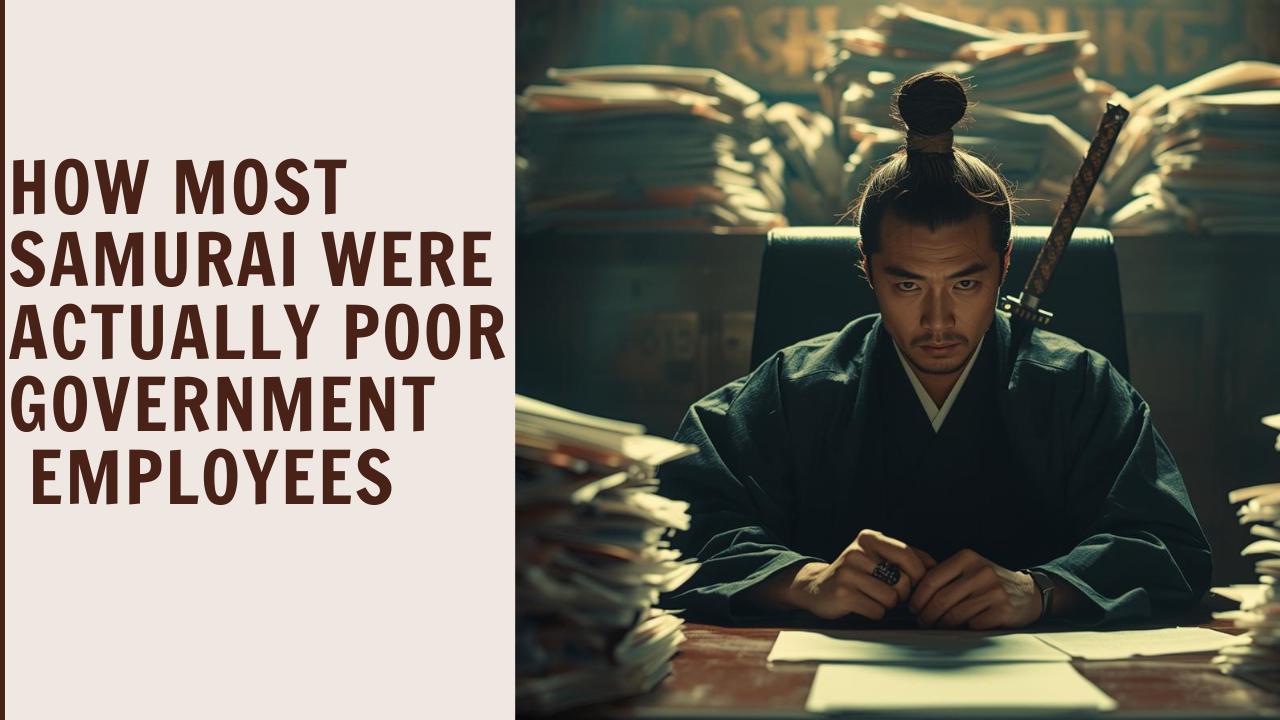
How Most Samurai Were Actually Poor Government Employees
The Reality Behind Japan's Romanticized Warrior Class
Watch the full video on our YouTube channel: Click here
Close your eyes and picture a samurai.You're probably seeing:
A master swordsman in pristine armor.
A noble warrior living by a strict honor code. Wealth, respect, discipline, and deadly skill with a katana.
A life of purpose, combat, and unwavering loyalty.
Now open your eyes and face reality:
Most samurai were broke government workers doing paperwork who never fought anyone, struggled to pay their bills, and made umbrellas as side jobs to afford basic expenses.
The samurai image burned into global consciousness through movies, anime, and romanticized history is based on a tiny fraction of samurai history.
The warrior samurai. The ones who fought in actual battles during Japan's century and a half of civil war.
The other 265 years when samurai were government bureaucrats?
Conveniently ignored.
This is the true story of what most samurai actually were not elite warriors, but civil servants trapped in a rigid class system, economically struggling, and spending their days doing the same boring administrative work that makes modern office workers fantasize about "simpler times."
Spoiler: The times weren't simpler. They were just boring in different ways.
The Feudal System:
When "Elite" Means Millions of People
Understanding the Samurai Class
Let's start with a fundamental misunderstanding:
Samurai weren't a small group of elite warriors.
They were an entire social class.
During the Edo period (1603-1868), samurai made up approximately 5-10% of Japan's population.
That's millions of people over the course of 265 years.
Think about that for a second.
If 5-10% of a population are elite warriors, you don't have an elite force. You have a massive bureaucratic class that happens to carry swords.
Modern comparison:
The United States has about 330 million people. If 5-10% were elite warriors,that's 16-33 million people. That's not special forces. That's not even the entire military.
That's just... a lot of people with a specific job classification.
The Feudal Pyramid:
Feudal Japan's social structure looked like this:
At the top:
Emperor:
Ceremonial figurehead with little actual power·
Shogun:
Military dictator with real authority.
Below that:
Daimyo:
Regional lords who governed territories.
Below that:
Samurai:
The warrior class (but "warrior" is misleading, as we'll see)
At the bottom:
Peasants, artisans, merchants:
Everyone else Samurai weren't nobles in the European sense. They were retainers employees of the daimyo.
They received stipends (salaries) in exchange for service.
They couldn't own land. They couldn't engage in commerce.
They were government employees. With swords and social prestige, sure. But government employees nonetheless.
The Edo Period:
265 Years of Nothing to Fight
Japan's Long Peace
In 1603, Tokugawa Ieyasu unified Japan and established the Tokugawa shogunate. This began the Edo period, which lasted until 1868.265 years.You know what defined the Edo period?
Peace. Almost no wars. No major conflicts. Japan was unified, stable, and isolated from foreign influence.
This created a massive problem for the samurai class.
Samurai existed to fight. They were warriors. Their entire identity was built around combat readiness and military service.But there was nothing to fight.
The Warrior Problem
Imagine being a professional soldier in a country that hasn't had a war in 150 years. You're still employed. You still wear the uniform. You still carry weapons.But your job has fundamentally changed. You're not a soldier anymore. You're... something else.
That's what happened to samurai during the Edo period.
The shogunate couldn't just eliminate the samurai class they were too entrenched in the social structure.
But they also didn't need millions of warriors with nothing to do.
Solution:
Turn them into bureaucrats.
What Samurai Actually Did:
The Boring Truth
The Real Samurai Job Description
During the Edo period, samurai duties included:
Tax Collection:
The most common samurai job. Going door to door (or farm to farm) collecting rice taxes from peasants. Keeping records. Reporting to superiors. Dealing with complaints.
Essentially:
The IRS. With swords.
Government Administration:
Record keeping. Filing documents. Maintaining archives. Managing correspondence between different levels of bureaucracy.
Modern equivalent:
Government data entry clerks.
Middle Management:
Overseeing public works projects. Managing laborers. Supervising construction. Reporting progress to higher-ranking samurai.
Modern equivalent:
Construction site supervisors, project managers.
Law Enforcement:
Some samurai served as police officers. Investigating crimes. Maintaining order. Handling disputes. Patrolling streets.
Modern equivalent:
Police officers doing paperwork between patrols.
Education:
Teaching reading, writing, mathematics, and Confucian ethics to children of samurai families. Running schools. Creating curriculum.
Modern equivalent:
Public school teachers.
Ceremonial Duties:
Attending official functions. Standing guard at important events. Participating in formal rituals. Looking dignified and official.
Modern equivalent:
Honor guards, ceremonial military units.
Notice What's Missing?
Fighting wars. Engaging in combat. Using swords against enemies. Anything remotely "warrior-like."
Most Edo-period samurai never fought anyone. They never engaged in battle. They never used their swords for anything more dangerous than cutting food or maybe defending against a random criminal.
They were office workers. Government employees. Civil servants.With excellent job security, social prestige, and cool outfits. But fundamentally, they were bureaucrats.
The Money Problem:
When Warriors Are Broke
The Samurai Salary System
Samurai were paid in rice. Their stipend was measured in koku one koku being approximately 180 Kilos of rice, supposedly enough to feed one person for one year.
The salary breakdown:
High-ranking samurai (very few):
5,000-10,000+ koku per year Wealthy, comfortable, multiple residences· Could afford extensive training and proper equipment
Mid-ranking samurai (minority):
500-1,000 koku per year· Comfortable but not wealthy· Could maintain proper appearances
Low-ranking samurai (the majority):
50-100 koku per year.Barely enough to survive.Constantly struggling financially
The Expense Problem
Lower-ranking samurai—the vast majority—faced crushing expenses.
Required costs:
Housing:
Had to live in designated samurai districts (expensive)·
Clothing:
Required to wear proper samurai attire (expensive)·
Weapons and armor:
Had to maintain swords, armor, other equipment (very expensive)·
Ceremonial obligations:
Expected to participate in formal events with appropriate gifts and offerings (expensive)·
Household maintenance: Supporting family, servants (if any), basic needs.
The math didn't work.
A low-ranking samurai receiving 50-100 koku per year had to stretch that rice stipend to cover all these expenses. Many couldn't do it.
The Debt Crisis
Many samurai were constantly in debt.
The irony:
Samurai looked down on merchants as a lower class. Merchants engaged in commerce, which was considered beneath the dignity of warriors.
But merchants had money. Samurai often didn't.
Merchants loaned money to samurai. Samurai borrowed to maintain appearances, cover expenses, and survive. Then they couldn't pay back the loans because their stipends were fixed and insufficient.
This created a bizarre dynamic:
The "noble warrior class" was often financially dependent on the "lower" merchant class they officially looked down upon.
Side Hustles:
When Warriors Make Umbrellas
The financial pressure got so bad that many samurai took side jobs.Yes, really. "Elite warriors" doing handicrafts at home to make ends meet.
Common samurai side hustles:
Making umbrellas:
Oiled paper umbrellas were in demand·
Crafting toothpicks:
Small, simple, could be made at home·
Creating fans:
Folding fans, decorative fans·
Weaving baskets:
Practical goods for sale·
Transcription work:
Copying documents for merchants·
Tutoring:
Teaching reading and writing to merchant children
Picture this:
A samurai, dressed in his formal attire during the day, sitting at home at night making umbrellas to sell so he can afford next month's rice and pay off debt to a merchant.
The noble warrior reduced to craftwork because his government salary doesn't cover basic expenses.
Modern equivalent:
An "elite special forces operator" working DoorDash on weekends because military pay doesn't cover rent in an expensive city.
That's not a far-fetched comparison. That's the reality most samurai lived.
Training Reality:
Too Expensive for Most
The Myth of Constant Training
Movies show samurai constantly training. Practicing sword techniques. Honing their skills. Maintaining combat readiness.
Reality:
Training was expensive, and most samurai couldn't afford it.
Costs of martial training:
Dojo fees:
Training schools charged for instruction·
Equipment:
Practice weapons, protective gear.
Time:
Training takes hours away from work and side jobs.
Travel:
Good dojos might require travel to access.
For wealthy samurai:
No problem. They had resources, time, and could dedicate themselves to martial excellence.
For low-ranking samurai:
Impossible. They were working full-time government jobs and doing side hustles to pay bills. When did they have time to train? How could they afford dojo fees when they were in debt?
The Skill Gap:
By the late Edo period, there were samurai who had never seriously trained with a sword.
They wore swords it was legally required for their class. But they'd never used them for anything except maybe cutting vegetables or defending against the occasional criminal.
The sword became a badge of office. A symbol of status. Not a weapon they actually knew how to use effectively.Like a police officer's badge today. It identifies you as having certain authority. But the badge itself isn't the tool you use every day.
The wealthy samurai?
Yes, they trained extensively. They maintained combat skills. They're the ones who appear in historical records as exceptional warriors.
The average samurai?
Basic competence at best. Their sword was more important as a status symbol than as a weapon.
The Bushido Myth: Invented After the Fact
"The Way of the Warrior"
Ask most people about samurai values, and they'll mention bushido "the way of the warrior." The code of honor.
Loyalty, discipline, honor, courage, self-sacrifice.
Here's the problem:
Bushido as we know it was largely created in the Meiji era (1868-1912).After the samurai class was abolished.
The Timeline Problem
Samurai era:
Roughly 12th century through 1868 (when class abolished)·
"Bushido" codified:
Late 1800s and early 1900s.
Most famous bushido text:
Hagakure, written in the early 1700s, wasn't widely known until the 20th century.
The bushido code as a unified, universal samurai philosophy didn't exist during most of samurai history.
Different clans had different values. Different periods emphasized different virtues. Some samurai were honorable and dutiful. Others were corrupt, lazy, or self-serving.
They were people.
With the same range of personalities, motivations, and ethical standards you'd find in any large group of humans.
Why Was Bushido Invented?
After the Meiji Restoration (1868), Japan rapidly modernized and westernized. The samurai class was abolished. The feudal system ended.
But Japanese nationalists wanted a unifying cultural identity.
Something distinctly Japanese. Something to instill discipline and loyalty in the new modern military and citizenry.
Solution:
Romanticize the samurai. Create "bushido" as a formal code.
Make samurai into symbols of Japanese values.
This served multiple purposes:
National identity building· Military culture creation· Moral education framework· Political propaganda (especially pre-WWII)
The noble samurai living by bushido became a myth used for nation-building.
And it worked. So well that even today, people worldwide believe bushido was a real, universally-followed code throughout samurai history.
It wasn't.
The Warrior Samurai:
They Did Exist (But Briefly)
The Sengoku Period:
Actual Warriors
Let's be clear.
There were warrior samurai.
Real ones. Who fought real battles.
The Sengoku period (1467-1615):
150 years of near-constant civil war. The Warring States period. Japan fractured into competing territories. Daimyo fought each other for control.
During this time, samurai were absolutely warriors:
Fought in major battles.
Conducted sieges.
Engaged in cavalry charges.
Used actual military tactics
Died in combat regularly.
Needed real combat skills to survive
These are the samurai we see in movies.
The warriors. The fighters. The tacticians.
Figures like:
Oda Nobunaga.
Toyotomi Hideyoshi.
Tokugawa Ieyasu.
Miyamoto Musashi.
Real warriors. Actual combat veterans. Legendary fighters.
The Math Problem
Sengoku period (war):
150 years
Edo period (peace):
265 years
Which period do they ignore?
The 265 years of bureaucracy.
Makes sense for entertainment.
Nobody wants to watch "Samurai Accountant: The Epic Tax Collection."
But it creates a massively distorted view of what most samurai, for most of samurai history, actually were.
The warrior samurai the real combat veterans were a minority.
And they existed during a specific, relatively brief period.
The bureaucrat samurai the government workers doing administrative tasks were the majority.
And they existed for much longer.
But we only remember the warriors.
Because warriors make better movies.
The Class System Trap:
Can't Quit, Can't Win
The Restrictions of Being Samurai
Being born into the samurai class wasn't all prestige and swords. It came with serious restrictions that trapped people in financially precarious situations.
You couldn't change professions:
Born samurai, die samurai.
Want to become a merchant and actually make money?
Can't do it. Want to be a farmer?
Forbidden.
You're locked into your hereditary position.
You couldn't marry outside your class:
Want to marry a wealthy merchant's daughter?
Nope. She's lower class, even if her family has way more money than yours. Marriage had to be within the samurai class.
You had to maintain appearances:
Even if you're broke, you must dress appropriately. Live in the right neighborhood. Behave with proper dignity. This costs money you might not have.
You couldn't engage in commerce:
Making money through business was beneath samurai dignity. You're a warrior class (even though you're doing paperwork). Commerce is for merchants.
You had obligations to your lord:
Your daimyo called?
You came. Immediately. Drop everything. Report for duty. No matter what it disrupts in your life.
The Prestige Trap:
You have high social status but no economic freedom.
You're technically elite but actually broke.
You're part of the warrior class but spend your life doing paperwork.
You can look down on merchants but borrow money from them constantly.
You carry swords as symbols of your status but many can't afford proper training to actually use them well.It's a trap. A gilded cage. Social prestige without economic opportunity. Status without freedom.
Many samurai realized this. Letters and diaries from the Edo period show samurai frustrated with their situation. Envious of merchants who had freedom and money. Feeling trapped by rigid social expectations and insufficient pay.
But they couldn't do anything about it.
The system locked them in place.
The End of the Samurai:
Obsolescence
The Meiji Restoration
In 1868, the Meiji Restoration began. Japan decided to rapidly modernize and westernize. Industrialization. Western military tactics. Modern government structures.
This meant the samurai class had to go.
The reforms:
1876:
Haitorei Edict Samurai could no longer wear swords in public. For a class defined by carrying swords, this was identity destruction.
1876:
Stipends Abolished Samurai rice payments ended. They received one-time payments as compensation and were told to find new employment.
Result:
Samurai became regular citizens. Find a job. Figure it out. Your hereditary position is over.
The Satsuma Rebellion (1877)
Some samurai couldn't accept this. Led by Saigo Takamori, about 20,000 samurai rebelled against the Meiji government.
They wanted the old system back. Warrior culture. Samurai privileges. Traditional values.
The problem:
They were fighting with swords and traditional weapons against a modern conscript army with rifles and artillery.
The result:
They lost. Badly.
The Satsuma Rebellion is often romanticized:
The last stand of the samurai. A noble, honorable defeat. Warriors going out in glory.
The reality:
Desperate men with outdated weapons and obsolete skills getting destroyed by modern military technology.Swords vs. guns. Honor vs. practicality. Tradition vs. modernity.
Guns won.
As they always do.The samurai era ended not with honor, but with obsolescence. Their skills were outdated. Their class system was inefficient. Their military relevance was gone.
What Happened to Former Samurai?
After abolishment, former samurai scattered into different paths.
Some became businessmen:
Used their education and connections in the new economy.
Some became teachers:
Educated people were needed in modernizing schools.
Some became police officers:
Maintained some connection to order and authority.
Some became military officers:
In the new westernized military.
Some struggled and failed:
Couldn't adapt to the new worldThe transition was difficult. Imagine being told your family's 20-generation identity is over. Figure out a new career. Good luck.Many adapted. Many struggled. The samurai class that had existed for centuries was gone within a generation.
Why We Remember Warriors, Not Bureaucrats
The Romanticization Process
After the samurai class ended, Japan began romanticizing them almost immediately.
Why romanticize samurai?
National identity:
Creating symbols of Japanese values and culture.
Military culture:
Instilling discipline in the new modern military.
Political purposes:
4. Make them symbols of honor, loyalty, discipline.
Nostalgia: Longing for a "simpler" past (that wasn't actually simpler)
The process:
1.Take the warrior samurai (minority, brief period)
2. Create "bushido" as their code (mostly invented)
3. Ignore the bureaucrat samurai (majority, long period)
4. Make them symbols of honor, loyalty, discipline
5. Use them for nation-building and propaganda.
Hollywood Discovers Samurai
After World War II, Akira Kurosawa started making samurai films.
Seven Samurai (1954). Yojimbo (1961). Sanjuro(1962).
These films were incredible.
Masterpieces of cinema.
They focused on you guessed it warrior samurai. Ronin. Fighters. Combat.
Hollywood adapted them:
The Magnificent Seven (1960, based on Seven Samurai). A Fistful of Dollars (1964, based on Yojimbo).
The West fell in love with samurai.
The honor. The discipline. The aesthetic. The philosophy. The swordsmanship.
Anime and manga continued the romanticization. R
urouni Kenshin. Samurai Champloo. 47 Ronin. Countless others.
Video games joined in.
Ghost of Tsushima. Sekiro. Nioh. All featuring warrior samurai.
The image became global:
Samurai = noble warriors living by honor code, masters of the sword, disciplined and deadly.
And the reality?
Forgotten. Ignored. Boring.Because "government bureaucrat collecting taxes and making umbrellas" doesn't make a good action movie.
Modern Equivalent:
Who Are Today's Samurai?
The Real Comparison
If most samurai were government bureaucrats, who are their modern equivalent?
Not special forces. Not martial artists. Not anyone combat-related.
The modern samurai are:Government office workers:
IRS agents collecting taxes.
DMV employees processing paperwork.
City administrators managing projects.
Social workers handling cases.
Government archivists maintaining records.
The comparison:
Necessary government jobs.
Generally underpaid.
Required to maintain certain standards.
Can't easily change careers (government benefits, pension concerns).
Social respect for the position (sometimes) but not wealth.
Some dedicated and excellent, some just getting by.
Mostly doing routine work with occasional interesting moments.
That's what most samurai were.
Government workers. Some dedicated, some lazy, most just trying to get through the day and afford their expenses.
The "elite warrior" image is as accurate for samurai as calling all government employees "elite public servants." Technically true in terms of classification. Wildly misleading in terms of reality.
The Conclusion: Bureaucrats With Swords
So here's the truth about samurai:
For every legendary warrior like Miyamoto Musashi who mastered the sword and fought duels.
there were thousands of samurai who:
Spent their careers collecting taxes.Struggled to pay bills on insufficient stipends.Made umbrellas at night to cover expenses.
Never seriously trained with their swords·
Died having never fought anyone·
Spent their entire lives doing routine government work.
That's not the story in the movies. That's not the image in anime.
They were the original office warriors.
That's not the myth.
But it's the truth.
And somehow, that truth is more interesting than the myth.
Watch the full video breakdown of samurai reality on YouTube! Click here
Subscribe to our channel for more stories about historical figures who were way more normal than legends suggest: Click here
About History's Hot Takes
We make history actually interesting by telling you what really happened—with sarcasm, modern comparisons, and facts you'll actually remember. History without the romanticization, myths, or boring lectures.
Follow us:·
YouTube: Link·