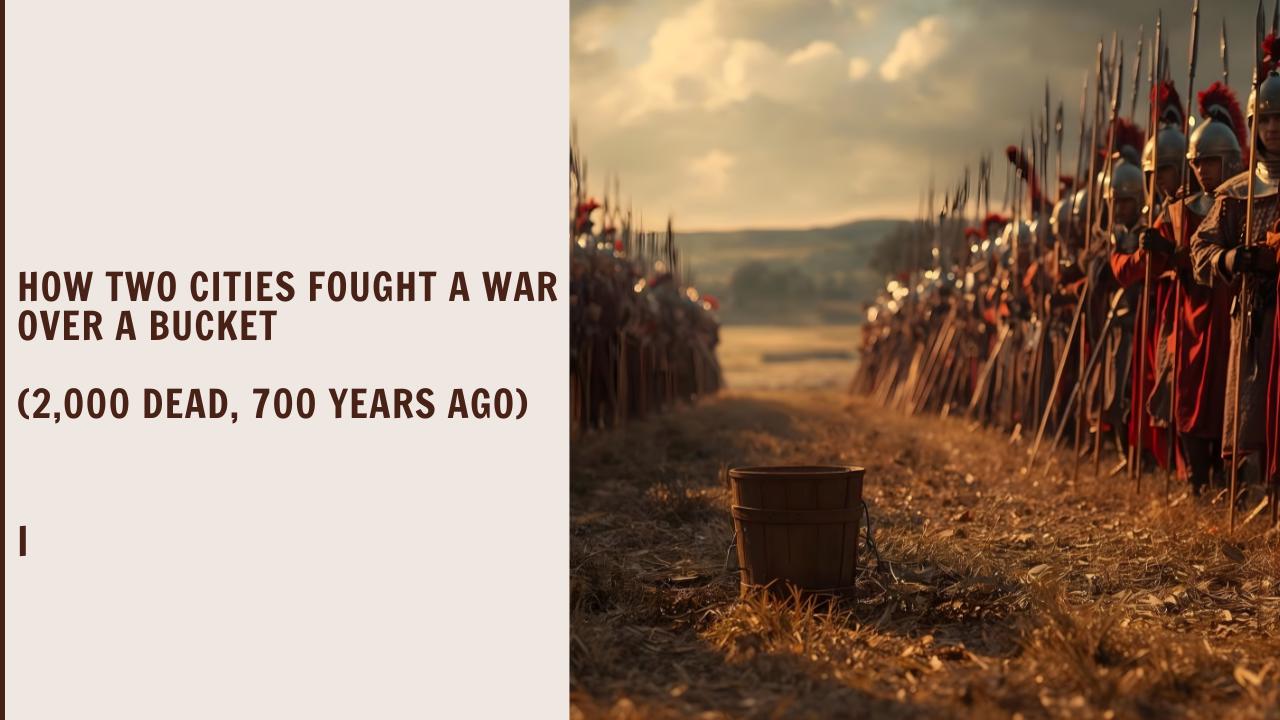
The War of the Bucket: How 2,000 People Died Fighting Over a Stolen BucketMedieval Italy's Pettiest War (And Why They Still Won't Give It Back After 700 Years)
By History's Hot Takes Reading time: 16 minutes[
Click here for the full youtube video
Imagine going to war over a bucket.
Not a golden bucket.
Not a bucket full of treasure. Just a regular wooden bucket for drawing water from a well.
Now imagine 2,000 people dying in that war.
And imagine that 700 years later, the city that stole the bucket still has it.
Still displays it proudly.
And still refuses to give it back.
You don't have to imagine.
It happened.
Welcome to the War of the Bucket, 1325. Medieval Italy's pettiest conflict, and proof that humans will fight over absolutely anything if you hurt their pride.
Let's dive in.
Medieval Italy:
A Recipe for Disaster
To understand how a bucket started a war, you need to understand medieval Italy in the 1300s.
Italy wasn't a unified country.
It was dozens of independent city-states.
Each had its own government. Its own army. Its own fierce local pride.And they all hated each other.
Bologna:
The Rich Kid
Bologna was one of the big players.Wealthy. Powerful. Home to one of Europe's oldest universities.They controlled important trade routes. They had money. They had influence.They knew it. And they weren't humble about it.
Modena:
The Scrappy Neighbor
Modena was smaller. Less wealthy. But fiercely independent.They lived in Bologna's shadow. They resented it.Bologna looked down on Modena. Modena resented Bologna's arrogance.They were neighbors. Close enough to be rivals. Close enough to hate each other properly.
The Political Powder Keg
It gets worse.Medieval Italy was divided into two major political factions:
The Guelphs
supported the Pope.
The Ghibellines
supported the Holy Roman Emperor.This wasn't just politics. This was religious. Ideological. Personal.
Bologna was Guelph.
Modena was Ghibelline.
They weren't just rival cities. They were on opposite sides of Italy's biggest political conflict.
For decades, they'd been fighting. Small raids. Border skirmishes. Petty theft.
Nothing major. Just constant, simmering hostility.
By 1325, there was an uneasy truce.
They pretended to get along while secretly despising each other.
Then someone stole a bucket.
The Theft That Changed Everything
The year was 1325.
The exact date is disputed, but it happened during one of many small raids between the cities.
Modena soldiers crossed into Bologna's territory.
A quick raid. Looking for something to steal. Supplies. Weapons. Anything valuable.
They're prowling around Bologna.
Checking houses. Wells. Storage buildings.
One soldier spots a wooden bucket sitting by a well.
It's just a bucket. For drawing water. Probably belonged to someone's house or a public well.
Nothing special. Nothing valuable.
He grabs it.
Maybe as a trophy. Maybe just because he needed a bucket. Maybe because it was there.
The Modena soldiers head home with their prize:
one wooden bucket.
They probably laughed about it. "Look what we took from Bologna!"It was a joke. A little souvenir from enemy territory.
Bologna didn't think it was funny.
Bologna's Response:
War
News reached Bologna that Modena had stolen from them.
A bucket.
Just a wooden bucket.But to Bologna, this wasn't about the bucket.
Pride and Honor
In medieval culture, honor was everything.
Your reputation. Your dignity. Your city's pride.Letting an insult go unanswered was weakness.
And Modena smaller, weaker, inferior Modena had just stolen from Bologna.
Bologna sent a message:
Give the bucket back.
Modena's response: No.
The Escalation
Bologna sent another message. More forceful this time.Return the bucket. Now.
Modena refused again.
Why would they give it back?
They'd taken it fair and square. It was theirs now.Besides, Bologna couldn't make them do anything.
This was about principle now.
About power.
About who could push whom around.
Bologna had a choice:
Accept the humiliation. Let Modena get away with stealing from them. Look weak.
Or do something about it.
They chose violence.Bologna declared war.
Over a bucket.
The Armies Mobilize
To be fair, it wasn't JUST about the bucket.
The bucket was the excuse.
The final insult. The spark that lit decades of accumulated resentment.
But still.
The official reason for war was:
Modena stole a bucket and won't give it back.
Bologna's Army
Bologna had money. They assembled a large force.Professional soldiers. Hired mercenaries. Allied city-states who also hated Modena.
Approximately 32,000 soldiers.Infantry with swords and spears. Cavalry on horses. Archers.
The works.They were confident.
This would be quick. Modena couldn't possibly match their strength.
Modena's Response
Modena couldn't match Bologna's wealth.But they had allies too. Other Ghibelline cities who hated the Guelphs. Who hated Bologna.They pooled their forces.Approximately 35,000 soldiers.Slightly outnumbering Bologna.This was going to be a real war.Over 60,000 soldiers total. Facing each other over a bucket.
November 15, 1325:
The Battle of Zappolino
The two armies met at Zappolino, a field between Bologna and Modena.November 15, 1325. A day that would go down in history for all the wrong reasons.
Over 60,000 men. Armed with medieval weapons. Ready to kill each other.Over a bucket.
The Fighting Begins
Bologna was confident. They had a strong army. Good equipment. This would be over quickly.Modena knew they were fighting for survival. And for keeping that bucket.
The battle began.
It was brutal.Medieval warfare wasn't like modern combat. No guns. No artillery. No distance.Just men with swords, spears, and axes. Hacking at each other.
Face to face.Cavalry charges crashed into infantry lines. Horses trampled fallen soldiers. Arrows flew in volleys, finding their marks.Blood soaked the field.
The battle lasted hours.Men screamed. Men died. Men fought over a stolen bucket.
The Tide Turns
Slowly, Bologna started losing.
Their lines began to break.
Their soldiers started retreating.Modena's forces pushed harder.
Sensing victory.
Bologna's army routed.
Complete defeat.
Their soldiers fled.
Modena's cavalry pursued,cutting down the retreating troops.
It was a massacre.
The Final Count
When the dust settled:
Approximately 2,000 soldiers dead.
Thousands more wounded.Hundreds of Bologna prisoners captured.Bologna had lost decisively.And Modena still had the bucket.
The Aftermath:
Victory and Pettiness
Modena's army returned home as heroes.
They'd defeated Bologna.
Beaten the wealthy, arrogant city that looked down on them.
And they still had the bucket that started it all.
Bologna was devastated.
They'd lost a major battle. Lost soldiers. Lost honor.And they STILL didn't have their bucket back.
The Peace That Followed
Eventually, the war ended. Peace treaties were signed.Borders were settled. Prisoners were exchanged.Bologna, in peace negotiations, asked one more time for the bucket.
Modena said no.
They'd won the war. They'd earned the bucket. It was staying in Modena.
They placed it in a tower. The Ghirlandina Tower, next to Modena's cathedral.As a trophy. A symbol of their victory over Bologna.And that's where it stayed.
700 Years Later:
The Bucket Endures
Centuries passed.Italy unified in the 1800s. Bologna and Modena became part of the same country.The political divisions that fueled the war Guelphs vs. Ghibellines became history.The rivalry faded.
Today, Bologna and Modena are friendly Italian cities.
But Modena still has the bucket.
You Can Visit It Today
The bucket is still in the Ghirlandina Tower in Modena.You can visit it. It's a tourist attraction.People come from all over to see "the bucket that started a war."It sits behind glass. Wooden. Old. Well-preserved for being 700 years old.There's a plaque explaining its history. The raid. The war. The 2,000 deaths.All over this bucket.
Bologna Still Asks
Over the centuries, Bologna has occasionally asked for the bucket back.Multiple times. Different eras. Different governments.Modena's answer is always the same:
No.
We won the war. We earned it. It's ours.700 years of pettiness. And counting.
Is It Even the Real Bucket?
Here's where it gets interesting.Some historians aren't sure the bucket on display is the original.
700 years is a long time. Wood deteriorates. The bucket might have been replaced at some point with a replica.
Modena insists it's the original.Historians are skeptical.But honestly?
Most don't care.Real or replica, it represents something important.
The pettiest war in history.And the story is too good to ruin with facts.
Why Did This Happen?
Understanding Medieval Logic
Looking at this story from our modern perspective, it seems insane.
2,000 people died over a bucket?
How?
But understanding medieval culture makes it clearer.
Pride Was Everything
In medieval society, honor and reputation were more valuable than life itself.Your word. Your dignity. Your city's pride.These things mattered more than money. More than safety. Sometimes more than survival.Letting an insult go unanswered was weakness. It invited more insults. More attacks.You defended your honor. Always. No matter the cost.The bucket wasn't valuable. But the act of stealing it and refusing to return it? That was an insult that couldn't be ignored.
Symbolism Over Substance
The bucket became a symbol.For Bologna:
Their stolen property. Their violated dignity. Modena's disrespect.For Modena: Their defiance. Their refusal to bow to Bologna's demands.
Their independence.It wasn't about the bucket's function. It was about what it represented.
Modern equivalent: Sports team rivalries. The trophy isn't valuable metal. It represents victory. Dominance. Bragging rights.
Nobody gives back championship trophies because "it's just metal."
The Bucket Was the ExcuseT
he war wasn't really about the bucket.It was about:
- Decades of rivalry
- Political opposition (Guelph vs. Ghibelline)
- Religious conflict (Pope vs. Emperor supporters)
- Economic competition
- Territorial disputes
- Accumulated grievances
The bucket was just the trigger. The excuse. The thing that made it acceptable to finally go to war.Throughout history, wars have official reasons and real reasons. They're rarely the same.
Other Petty Wars:
Modena Wasn't Alone
The War of the Bucket is the most famous petty war, but it's not unique.History is full of conflicts that started over ridiculous things.
The Football War (1969)
El Salvador and Honduras went to war after a soccer match.Actually, it was about immigration issues and land disputes. But it was triggered by riots during World Cup qualifying matches.100 people died. Over soccer.
The War of Jenkins' Ear (1739)
A Spanish coast guard cut off British sailor Robert Jenkins' ear.Jenkins showed his severed ear to British Parliament. Britain declared war on Spain.The war lasted 9 years. Over 100,000 people died.Over an ear.
The Pig War (1859)
An American farmer shot a British pig that was eating his potatoes on disputed territory between the US and Canada.Both countries mobilized military forces. It nearly became a full war.Fortunately, cooler heads prevailed. Nobody died.But they almost went to war. Over a pig. Eating potatoes.
The Pastry War (1838)
A French pastry chef in Mexico claimed Mexican officers ate his pastries without paying.He demanded compensation. The Mexican government refused.France sent warships and invaded Mexico.Seriously. France invaded Mexico. Over unpaid pastries.
What the Bucket War Teaches Us
The War of the Bucket might be the pettiest because:
- 2,000 people actually died
- It was literally over a household item
- Modena STILL won't give it back
- 700 years later, the pettiness continues
It's the perfect encapsulation of human nature:
We're prideful, stubborn, and willing to fight over almost anything if you frame it right.
The Lessons:
What We Can Learn
So what does a 700-year-old war over a bucket teach us?
Lesson 1:
Pride Beats Logic
Humans aren't rational. We're emotional.We care about respect, dignity, and honor more than we care about practical outcomes.The bucket had no value. But pride? Pride is priceless.This applies today. People destroy their own lives defending their ego. Businesses fail because leaders won't admit mistakes. Countries go to war over insults.Pride is powerful. And dangerous.
Lesson 2:
Symbols Matter More Than Reality
The bucket itself was worthless. What it represented was everything.To Modena: Victory. Independence. Defiance.To Bologna: Humiliation. Disrespect. Defeat.The physical object doesn't matter. The meaning does.Modern application: Brand loyalty. Political symbols. Sports team allegiances. Religious icons.The object itself is just stuff. But what it represents? People will fight for that.
Lesson 3:
Conflicts Are About More Than the Surface
The war wasn't about the bucket. The bucket was the excuse.When conflicts seem irrational, look deeper. There's always more going on.Decades of resentment. Power struggles. Identity conflicts. Accumulated grievances.The surface reason is rarely the real reason.Understanding this helps us avoid unnecessary conflicts. And resolve real ones.
Lesson 4:
Pettiness Is Forever
Humans hold grudges. We're petty. We keep our trophies.700 years. Modena has kept Bologna's bucket for 700 years.We like to think we've evolved beyond this. But we haven't.People stay mad for decades over small slights. Families feud for generations. Nations remember historical grievances for centuries.The War of the Bucket is just an extreme example of something universal: Humans never forget. And we rarely forgive.
Lesson 5:
Sometimes It Really Is About Principle
"It's the principle of the thing."You've heard this. You've probably said this.It's why Modena won't give the bucket back.
Why Bologna kept asking for it.Sometimes, giving in even when it costs you nothing feels like defeat.Sometimes, holding your ground even when it gains you nothing feels like victory.
Is this logical? No.Is this human? Absolutely.
The Modern Relevance
You might think this is ancient history.
Irrelevant to modern life.But the War of the Bucket reveals something timeless about human nature.
We're Still Fighting Over Buckets
Not literal buckets. But symbolic ones.Social media arguments that escalate wildly. Office feuds over minor slights. Political battles over symbols.The medium changes. The psychology doesn't.Someone takes something that's "yours" attention, credit, respect, status.You demand it back. They refuse.Suddenly you're in a war. Over something that didn't matter until someone tried to take it.
The Escalation Pattern
The War of the Bucket follows a pattern we see constantly:
- Small incident occurs
- Pride gets involved
- Neither side can back down
- Escalation
- Massive overreaction
- Consequences far exceed the original issue
Sound familiar?International conflicts. Family arguments. Workplace disputes.Same pattern. Every time.
Breaking the Cycle
Understanding the War of the Bucket helps us recognize when we're in this pattern.When pride matters more than outcomes.When we're fighting over symbols instead of substance.When we're escalating over buckets.Sometimes the right move is to give back the bucket. Or let them keep it.Sometimes winning isn't worth 2,000 deaths.Sometimes being right isn't worth destroying the relationship.
The War of the Bucket is a warning:
This is where pride leads when left unchecked.
The Final Lesson
The War of the Bucket is funny. It's absurd. It's ridiculous.But it's also deeply human.
We fight over symbols. We defend our pride. We refuse to back down.
We'd rather go to war than admit we're wrong.We'd rather keep a stolen bucket for 700 years than give an inch.
Is this rational?
No.
Is this who we are?
Yes.
The War of the Bucket isn't ancient history. It's human nature.And human nature doesn't change.We're still fighting over buckets. We just call them different things now.
The question is:
What's your bucket?
What are you holding onto out of pride? What conflict are you escalating over something that doesn't really matter?What war are you fighting that you could end by just giving back the bucket?Or are you like Modena determined to keep your trophy, no matter what, because you earned it?
Either way, the War of the Bucket has something to teach you.Sometimes we need to hear about an army fighting over a bucket to realize how absurd our own conflicts are.And sometimes we need to remember that giving back the bucket doesn't make you weak.It makes you wiser than medieval Italy.
Watch the Full Story click here
Subscribe to History's Hot Takes for more stories about historical events that sound absurd but are 100% real—new videos every week proving that humans have always been ridiculous.Because nothing says "proportional response" quite like mobilizing 60,000 soldiers over a stolen bucket.
Explore More Historical Absurdity📺 WATCH NEXT on History's hot takes:
- The Battle of Karánsebes: When an Army Fought Itself
- The Great Emu War: When Australia Lost to Birds
Sources:
- Medieval Italian city-state records (Bologna and Modena archives)
- "The War of the Bucket" - Various medieval historians
- Battle of Zappolino military records (1325)
- Contemporary chronicles from Guelph and Ghibelline sources
- Modern historical analysis of medieval Italian conflicts
- Ghirlandina Tower historical documentation
Note: Casualty numbers vary between historical sources, ranging from 150 to 2,000. We cite commonly accepted figures from multiple verified sources. The bucket's authenticity is debated among historians.