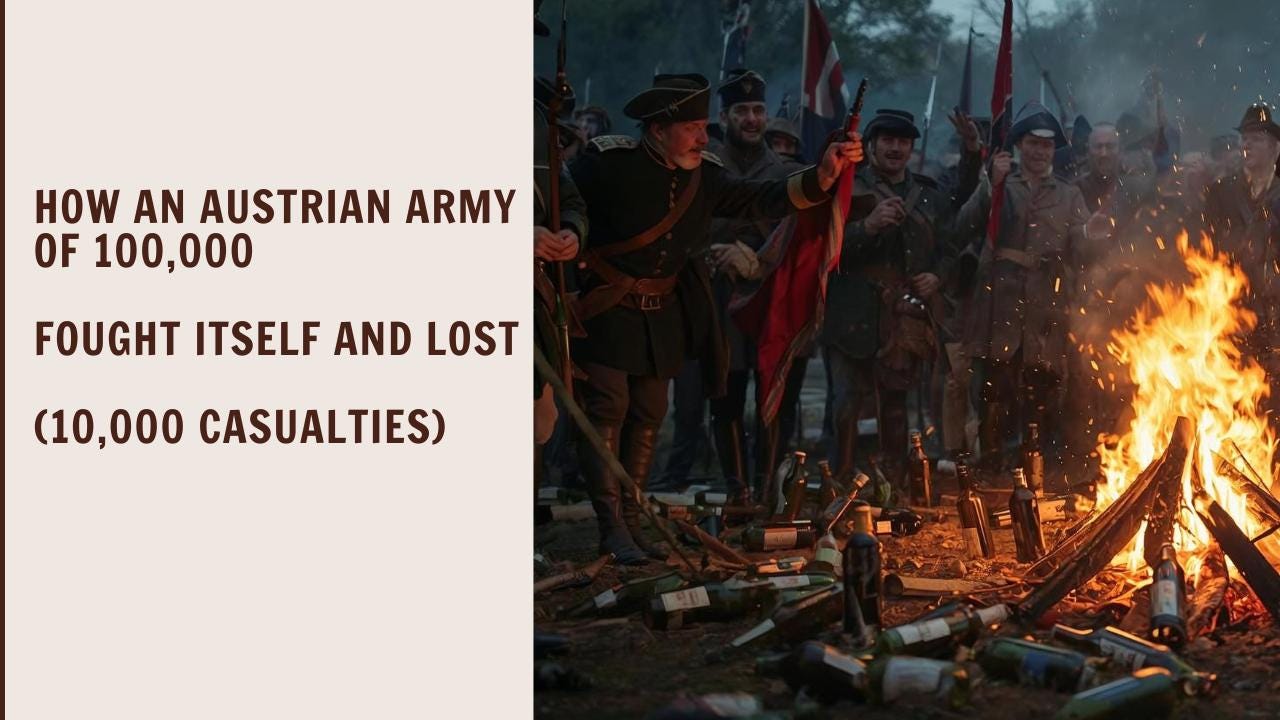
The Battle of Karánsebes: When an Austrian Army Fought Itself (And Lost)
How 100,000 Soldiers Killed 10,000 of Their Own Men Before the Enemy Even Arrived
By History's Hot Takes (Chuck)
Reading time: 18 minutes[
Watch the full video on Youtube click here
Imagine this: You're commanding an army of 100,000 soldiers.
You're marching to fight the Ottoman Empire.
You're confident.
Well-trained.
Well-armed.
And then your army spends two days shooting itself.
10,000 casualties.
Not from enemy action.
From your own troops firing at each other in the dark.
The enemy shows up two days later to find the mess you've made and takes the town without resistance.
This sounds like dark comedy. A satirical novel. A Monty Python sketch.
It's not. It's history.
Welcome to the Battle of Karánsebes, September 1788. The most embarrassing military disaster ever recorded.
Let's dive in.
The Setup:
A Multilingual Army That Couldn't Talk to Each Other
To understand how this catastrophe happened, you need to understand the Austrian army in 1788.The Austrian Empire was massive. It sprawled across Central Europe. And it was home to dozens of different ethnic groups.Germans. Hungarians. Serbs. Croats. Italians. Romanians. Czechs. Slovaks. And more.
All of these groups were conscripted into the same army.
The Communication Nightmare.
Here's the problem:
They didn't speak the same language.Austrian officers gave orders in German. That's fine if you're a German-speaking soldier from Vienna.
But if you're a Hungarian cavalryman?
You don't speak German.
If you're a Serbian infantryman? You speak Serbian.
Croatian soldier? Croatian.
Italian artilleryman? Italian.
The army tried to solve this with translators.
Officers would give orders in German.
Translators would relay them to different units in different languages.
But this is war.
Things happen fast.
Orders get garbled. Messages get lost.And that's in daylight, when everyone's sober and calm.
Now imagine it's nighttime. There's gunfire. Everyone's panicking. And nobody can understand the person next to them.
That's the Austrian army of 1788.
The Ethnic Tensions:
It gets worse.
These different ethnic groups didn't like each other.Germans looked down on Hungarians. Hungarians resented Germans. Serbs didn't trust Croats. Everyone had historical grievances.
They were forced to serve in the same army, but they barely tolerated each other.
This is important.
Because when things go wrong when panic starts people don't trust the person next to them.
They don't work together. They fragment.
Keep this in mind.
It's going to matter.
September 17, 1788:
The Stage is Set.
The Austrian Empire was at war with the Ottoman Empire.
This was the Austro-Turkish War of 1787-1791.
An Austrian army of approximately 100,000 soldiers was marching through what's now Romania, heading toward Ottoman territory.
On September 17, 1788, they reached the town of Karánsebes, on the Timiș River.
The Plan:
The plan was simple.
Cross the river
Set up camp
Prepare for battle with the Ottoman army, which was somewhere nearby
Defeat the Ottomans
Win glory for Austria
Simple, right?
The Scouting Party:
Austrian commanders sent hussars light cavalry scouts across the river first to make sure it was safe.Hussars were elite troops. Fast riders. Good fighters. Mostly Hungarian.They crossed the river. Looked around. No Ottomans anywhere.
All clear.
But they found something else:
Local Romani people selling barrels of schnapps.Strong alcohol.
Now, if you're a tired cavalry scout who's been marching for days, and someone's selling alcohol, what do you do?
You buy it.
The Drinking Party That Started a War (With Themselves):
The hussars bought the schnapps. Multiple barrels.And they set up their own little party on the riverbank.Drinking. Relaxing. Celebrating the fact that they weren't currently being shot at.
It must have felt like a victory.
They'd scouted ahead.
Found no enemies.
The mission was successful.Time to celebrate.
The Infantry Arrives:
Then the Austrian infantry crossed the river.These were foot soldiers. Regular troops. Not elite cavalry.And they'd been marching for days too. They were tired. They were thirsty.They saw the hussars having a party.
They saw the barrels of schnapps.
They walked over.
"Hey, share the alcohol."
The Refusal That Changed History:
The hussars said no.
Let me repeat that, because it's important:
Soldiers in the same army, marching to fight the same enemy, in the same war, refused to share alcohol with each other.
Why?
Ethnic tension.
The hussars were mostly Hungarian.
The infantry were mixed Germans, Serbs, Croats.
Class division:
Hussars were elite cavalry. Infantry were regular troops.Simple greed.
They'd bought the schnapps.
Why should they share?T
he infantry got angry.
Arguments started.
Shoving began.
Someone drew a weapon.T
he situation was escalating fast.
"Turks! Turks!" - The Shout That Destroyed an Army:
In the chaos, trying to scare off the infantry, one of the hussars had an idea.
A drunk idea.
He shouted: "Turci! Turci!"
That's Hungarian for "Turks! Turks!"
Maybe he thought it was funny. Maybe he thought it would make the infantry back off. Maybe he was just drunk and not thinking clearly.
Whatever his reasoning, it was the worst decision anyone made that day.
Why This Was Catastrophically Stupid:
Remember the context:
- It was dark. Night had fallen.
- They were in enemy territory.
- The Ottoman Turkish army was somewhere nearby.
- Everyone was on edge, expecting attack at any moment.
- Nobody trusted each other because of ethnic tensions.
And someone just yelled "TURKS!"
Instant Panic:
The infantry heard "Turks!" and panicked.
They couldn't see anything in the darkness. But they'd just heard that the enemy was here.So they did what soldiers do when they think they're under attack:
They started shooting.
The Chaos Spreads:
A Multilingual Disaster:
The infantry opened fire.
They couldn't see the enemy in the dark, so they shot at movement. At shadows. At sounds.Including the hussars.
The Hussars Fight Back:
The hussars, suddenly being shot at by their own infantry, thought the Ottomans were attacking.
So they shot back.At the infantry.At their own army.
More Soldiers Join In:
More Austrian soldiers heard gunfire.In the darkness and confusion, they assumed the battle had started.They grabbed their weapons and started shooting.
But nobody could see anything.It was nighttime.
There was smoke from gunfire everywhere. Chaos.Soldiers were shooting at anything that moved.At shadows. At sounds. At each other.
"Halt!" Becomes "Allah!":
Here's where the multilingual nightmare became catastrophic.
A German-speaking Austrian officer, trying to restore order,shouted:
"Halt!"Which means "Stop!" in German.Croatian soldiers nearby heard "Allah!"
And thought:
The Ottomans are attacking! They're shouting "Allah!"They started shooting at anyone near them.Serbian soldiers heard German commands they didn't understand. They assumed these were Turkish words. They panicked and fired.Hungarian cavalry heard shouting in languages they couldn't identify. They assumed it was the enemy. They charged.Italian infantry ran in a different direction.
Total Breakdown:
Within minutes, the entire army descended into chaos.Soldiers shooting in every direction.Cavalry charging blindly.Infantry firing at anything that moved.Officers shouting commands that nobody understood.And remember: There was not a single Ottoman soldier anywhere nearby.The Austrian army was fighting itself.
Then the Artillery Joined In:
If this sounds bad, it gets worse.Austrian artillery crews were positioned on high ground, overlooking the river crossing.They heard all the gunfire below. Hundreds of shots. Screaming. Chaos.Their officers assumed the army was under massive Ottoman attack.
So they did what artillery does:
They started firing cannons.
Shelling Their Own Troops:
Artillery shells began raining down on Austrian soldiers.
Explosions everywhere.Now the army wasn't just being shot at from all sides by confused infantry.They were also being shelled from behind by their own artillery.
The artillery crews couldn't see through the smoke and darkness. They had no idea they were firing on their own troops.
They just kept loading and firing. Into the chaos below.
Mass Panic:
This triggered total panic.Austrian soldiers abandoned their positions.
They fled in every direction.Cavalry trampled infantry trying to escape.More soldiers fired at the fleeing troops, thinking they were Ottomans.The artillery kept firing because they couldn't see what was happening.It was complete, catastrophic breakdown of military order.
The Emperor Almost Dies:
Emperor Joseph II himself was with the army.
When the chaos started, he tried to rally the troops. Restore order. Stop the panic.
He rode his horse toward the fighting, trying to command his soldiers to stop shooting.
Shot and Nearly Trampled:
Someone shot his horse.The Emperor fell.In the darkness and chaos, his own cavalry—fleeing in panic—nearly trampled him to death.They didn't recognize him. They just saw someone on the ground in their path.The supreme commander of the Austrian army was almost killed by his own troops.Eventually, some officers recognized him and pulled him to safety.But the chaos continued.
Two Days of Self-Destruction:
Here's the truly insane part:
This didn't last a few hours.
It lasted two days.September 17th and 18th, 1788.
Two full days of Austrian soldiers:
- Shooting each other
- Running in panic
- Being shelled by their own artillery
- Trampling each other
- Dying
All while fighting themselves.
Why Couldn't They Stop It?
You might wonder:
Why didn't someone just stop it?
Several reasons:
Darkness: Much of it happened at night. Nobody could see who was who.
Smoke: Gunfire created huge clouds of smoke. Visibility was near zero.
Language Barriers: Officers couldn't communicate with troops who didn't speak German.
Panic: Once panic starts in a military unit, stopping it is nearly impossible. It feeds on itself.
No Central Command: With the Emperor nearly killed and officers scattered, there was no unified command to restore order.
Continued Artillery: The artillery on high ground kept firing because they thought the army was still under attack.It was a perfect storm of disaster.And it just kept going.
September 19, 1788: The Ottomans Arrive:
On September 19, two days after the chaos started, the Ottoman army finally arrived.
They approached Karánsebes expecting a battle.They were ready to fight the Austrian army.
What They Found:
Instead, they found:
- Dead Austrian soldiers everywhere
- Wounded Austrian soldiers crying for help
- Abandoned Austrian positions
- Weapons and supplies scattered across the battlefield
- Complete chaos
- No resistance
The Ottoman commanders were confused.What happened here?
Did another army attack the Austrians?
Did we miss a major battle?
Piecing It Together:
Slowly, talking to wounded Austrian survivors and examining the scene, the Ottomans pieced together what happened.The Austrian army had fought itself.
There was no battle with Ottoman forces.No Ottoman attack.Just alcohol, confusion, multilingual chaos, panic, and friendly fire.The Ottomans took the town of Karánsebes without firing a single shot.
The Final Tally:
Let's look at the numbers:
Austrian Casualties:
- Dead: Thousands
- Wounded: Thousands
- Total: Approximately 10,000 casualties
- Cause: Self-inflicted
Ottoman Casualties:
- Dead: 0
- Wounded: 0
- Total: 0
- Why: They weren't there
Austrian Bullets Fired:
Approximately 9,860 rounds of ammunition
Ottomans Killed Per Bullet:
N/A (they weren't there)
Result: Total defeat of the Austrian army... by the Austrian army.
In Military Terms:
In military terminology, this wasn't just a defeat.It was a rout.A complete, catastrophic collapse.An army of 100,000 soldiers literally defeated itself before the enemy even arrived.
Did This Really Happen?
At this point, you might be skeptical.This sounds too ridiculous to be true. Surely this is exaggerated. A legend. A myth.Historians debated this for years.
The Evidence:
Austrian military records from this period are suspiciously incomplete.Official records downplay the incident or omit it entirely.Why?
Probably because it was incredibly embarrassing.
But here's the thing:
Multiple independent sources mention it.
Ottoman records:
Reference arriving at Karánsebes and finding Austrian casualties with no Ottoman engagement.
Contemporary accounts from 1788 describe the incident.
Soldiers' letters mention the chaos.
Newspaper reports from the time covered it.As historians cross-referenced these sources, the truth became clear:
Yes, it really happened.Maybe not exactly as dramatically as the most extreme versions claim. Casualty numbers vary between sources (some say 150, others say 10,000).
But the core story is true.An Austrian army, through a combination of alcohol, poor communication, ethnic tensions, panic, and friendly fire, inflicted massive casualties on itself while the enemy wasn't present.
Lessons From Karánsebes:
What Modern Militaries Learned:
The Battle of Karánsebes is actually taught in some military strategy courses.Not as a success story.As an example of what NOT to do.
Lesson 1:
Communication is Survival.
If soldiers can't understand each other, people die.Modern militaries use:
- Standard languages (English for NATO, aviation)
- Clear communication protocols
- Radio systems with designated channels
- Code words and signals everyone understands
- Redundant communication methods
Because Karánsebes showed what happens when you don't.
Lesson 2:
Discipline Prevents Disaster.
The hussars getting drunk and refusing to share started a chain reaction that killed 10,000 people.Modern militaries have strict regulations about:
- Alcohol consumption
- Maintaining watch
- Following orders
- Staying at posts
- Maintaining readiness
Because drunk soldiers make terrible decisions.
Lesson 3:
Technology Helps But Doesn't Solve Everything.
Even with night vision, radios, and GPS, friendly fire still happens.The fog of war is real. Chaos is always lurking.Technology reduces the problem. It doesn't eliminate it.Modern militaries understand this and train accordingly.
Lesson 4:
Panic is the Real Enemy.
More dangerous than the Ottomans. More dangerous than any external threat.Once panic starts, reason disappears. Training disappears. Discipline disappears.Military training today focuses heavily on:
- Stress inoculation
- Clear protocols for confusing situations
- Leadership under pressure
- Preventing panic spread
Because once it starts, stopping it is nearly impossible.Karánsebes proved that.
Lesson 5:
Never Underestimate Your Limitations.
The Austrian army was overconfident. They assumed nothing would go wrong.They didn't account for:
- Language barriers
- Ethnic tensions
- Human nature under stress
- The limitations of their communication systems
Modern militaries plan for failure. They assume things will go wrong and prepare accordingly.Because overconfidence kills.
The Dark Humor:
Funny and Tragic.
Here's the thing about Karánsebes:
It's both hilarious and horrifying.
Why It's Funny:
The premise is absurd.
Soldiers fighting over alcohol.
Someone yelling "Turks!" as a joke.
An entire army shooting itself for two days.
The enemy showing up like "What happened here?"
"Halt!" becoming "Allah!"
The Emperor being shot off his horse by his own troops.
The sheer incompetence of it all.
It reads like satire. Dark comedy. A Monty Python sketch.
Why It's Not Funny:
10,000 real people died or were wounded.
Soldiers who joined to defend their country. Who marched for days. Who never got to fight the actual enemy.
They died because of poor communication. Because of panic. Because of confusion.Real families lost fathers, sons, brothers.Not in glorious battle. Not fighting Ottomans. But shooting each other in pointless chaos.
The Balance:
You can acknowledge the absurdity while respecting the tragedy.It's okay to recognize that this is one of the most ridiculous things that ever happened in military history.While also understanding that real people suffered. Real lives were lost.The story is a reminder that war isn't glorious.It's often just chaos, confusion, and senseless death.Sometimes the enemy isn't even there.And you kill yourselves anyway.
Could This Happen Today?
The big question:
Could something like Karánsebes happen with a modern military?
What's Changed:
Modern militaries have:
Better Communication:
- Radios with encrypted channels
- Satellite communications
- Clear command structures
- Standard languages
- Real-time coordination
Better Identification:
- IFF (Identification Friend or Foe) systems
- GPS tracking
- Night vision
- Thermal imaging
- Unique radio signatures
Better Training:
- Stress inoculation
- Clear protocols for confusion
- Extensive friendly fire prevention training
- Communication drills
- Panic prevention
Better Discipline:
- Strict alcohol regulations
- Professional military culture
- Clear chain of command
- Accountability systems
What Hasn't ChangedBut some things are the same:Human Nature:
- People still panic under stress
- Confusion still happens
- Mistakes still occur
- Communication still breaks down under pressure
The Fog of War:
- Chaos is inherent to combat
- Uncertainty is constant
- Things go wrong
- Technology fails
Friendly Fire Still Happens:
- Iraq and Afghanistan proved this
- Despite all our technology
- Despite all our training
- It still occurs
The Answer:
Could an exact repeat of Karánsebes happen? Probably not.Modern militaries have too many safeguards.Could something similar happen on a smaller scale? Yes.And it has. Operation Cottage. Highway of Death. Incidents in Iraq and Afghanistan.
Friendly fire is a persistent problem.Karánsebes is just the most extreme historical example.
A reminder that no matter how advanced your military, human error and chaos are always lurking.
Why We Remember Karánsebes:
The Battle of Karánsebes has become legendary for several reasons:
It's Unbelievable But True.
The story sounds fake. It reads like fiction.But it's real.
Documented. Verified by multiple sources.T
hat combination absurdity plus truth makes it memorable.
It's Darkly Funny:
There's something inherently comedic about an army fighting itself.
The "Halt!"/"Allah!" moment is peak dark comedy.The hussars refusing to share alcohol leading to 10,000 deaths is tragic irony.
The Emperor being shot by his own troops is absurdist theater.We laugh because the alternative is crying.
It's Educational:
The story teaches real lessons about:
- The importance of communication
- The dangers of overconfidence
- How panic spreads
- Why friendly fire happens
- Human nature under stress
It's memorable because it's instructive.
It's Humanizing:
The Austrian army wasn't stupid. They weren't incompetent.They were humans dealing with impossible circumstances.Multiple languages. Darkness. Confusion. Stress. Fear.Under those conditions, disaster was almost inevitable.Karánsebes reminds us that military disasters aren't always about stupidity.
Sometimes they're about humans being human.
The Modern Legacy:
Today, Austria has largely embraced the Karánsebes story.It's taught in military academies worldwide.It's become internet famous memes, videos, Reddit threads.
Educational Value:
Military historians cite Karánsebes when teaching about:
- Friendly fire prevention
- Communication importance
- Panic management
- The fog of war
- Human factors in military disasters
Pop Culture:
The story has appeared in:
- History documentaries
- Military history books
- Internet memes
- YouTube videos (like this one!)
- Reddit threads
- Military humor compilations
It's become the go-to example of "military disaster caused by communication breakdown."
Austrian Response:
Austria doesn't hide from it anymore.They acknowledge it happened. They study it. They learn from it.It's part of military history education.Because the best way to honor those who died is to ensure it never happens again.
The Takeaway:
War is chaos.
Communication matters.
Panic is contagious.
Alcohol and combat don't mix.
Overconfidence kills.
And sometimes, the real enemy is yourself.
Final Thought:
The soldiers who died at Karánsebes didn't die for glory. They didn't die fighting bravely. They didn't die defending their homeland.T
hey died because of confusion, poor communication, and panic.
Their deaths were pointless. Tragic. Avoidable.But we can honor them by learning from their disaster.By understanding what went wrong.By ensuring modern militaries never repeat those mistakes.
That's the legacy of Karánsebes.
Not glory.
But lessons.Bitter, hard-won lessons written in the blood of 10,000 soldiers who fought themselves.
Watch the Full Story on Youtube Click here
Subscribe to History's Hot Takes for more stories about historical events that sound fake but are 100% real new videos every week proving that truth is stranger than fiction.Because nothing says "military excellence" quite like spending two days shooting yourself while the enemy watches from a safe distance.
Sources:
- Austrian military archives (1788-1789)
- Ottoman Empire historical records
- "The Austro-Turkish War 1787-1791" - Multiple historical sources
- Contemporary newspaper accounts from 1788
- Military strategy textbooks citing Karánsebes
Note: Casualty numbers vary between historical sources, ranging from 150 to 10,000. We cite commonly accepted figures from multiple verified sources.